STACEY WILK SAID WHAT?…Friendships are Like Paper Plates

cat-landing-plates-pistoulet

Italian Mama and author Stacey Wilk is one tough cookie when it comes to friendship. “Friendships are disposable,” she writes, “like paper plates.”

She’s not alone.

Social media posts, quotes, and related articles often remind me that one’s circle of friends typically shrinks with age. People come in and out of our lives depending upon the circumstance and purpose.

As one who didn’t learn how to be a good friend until well into adulthood, I think mindless disposal is a shame. You never know what weight the plate carried in the past. I’d like to hope that with a wipe down, delicate wash, or elbow grease most friendships are recyclable.

So what’s in your cupboard? Paper? Stoneware? Or perhaps, plastic? You know the plates; shiny, sturdy glorified paper disguised as stoneware.

A Pleasant Passover

Seder table picture

FIFTH PLACE WINNER – INSPIRATIONAL CATEGORY

11584-WDAN-AW

Kveller

Born into a Catholic family with a Jewish surname, I should have expected that I would one day find myself leading a Passover Seder.

To date, Mac and I have hosted eight Seders, seven of which I’ve had the honor to lead. This role was bestowed upon me after my Jewish husband concluded that in light of my organized, creative, teacher-like nature, I was the right person for the job. The trade off was food prep, which he happily agreed to tackle. Not one who enjoys cooking, I acquiesced. Besides, the man makes a mean brisket.

I love a good Passover Seder.

The parallels to the Easter story coupled with the springtime symbolism and my personal affection for The Ten Commandments movie make Passover a welcomed and relatable holiday.

The Seder service creates a setting where both the newcomer and the experienced guest feel connected.

It’s a forum to discuss physical and emotional freedom, think about the responsibility one has to repair the world, question injustice, and reflect on values and relationships. The Story of Exodus and the blessings translate into modern life and are meaningful for young and old, regardless of ethnicity or faith.

Lastly, the traditions are designed to keep children engaged, which make it easy to add elements of fun.

I didn’t always love a Seder.

In the beginning, I found it a tough ceremony to swallow. I felt like the token Christian; the stranger in the wrong outfit eating the matza out of order. The structure of the service confused me and the intensity associated with staying on task gave me the perfect excuse to keep quiet. I felt excluded by the deluge of Hebrew spoken by those in the know and in general, lost; drowned in a Red Sea of rigidity, pomp, and circumstance. For years, I couldn’t wait to suck down that fourth cup of wine and hightail it home.

Determined to do right by my Catholic self and our Jewish children, I set out on a mission to create an outreach friendly Seder.

I compiled a Hagaddah chock full of catchy ditties, kid friendly verses, and hands on plagues. I switched up the order of the service, made the blessings accessible in English and Hebrew, added passages about civil rights and the human condition, and offered readings that would appeal to different belief systems.

It took a few years to earn our Seder hosting chops, but eventually Mac and I found something that worked for us.

Fast forward to Passover 2014.

Walking by a local church the morning of Passover I noticed a passage carved into the steeple.

How wonderful it is

How pleasant for God’s people

To live together in harmony

Psalm 133

I thought about our Seder guests. That evening, sixteen people; Jews, Catholics, Muslims, a son of Methodist missionaries, family, old friends, and new faces would gather around our table in Pleasantville like a bona fide interfaith, intergenerational jamboree.

As suspected, it turned out to be just that.

We waited to kickoff the festivities so my Muslim neighbor could run home to say her afternoon prayers.

My father, a good ole boy and the son of Methodist missionaries who has a mezuzah affixed to his doorpost out of respect for our Jewish ancestors, joined us for his first Seder and my first holiday with him since I was a baby.

Adults and young people alike wore sunglasses to symbolize darkness, the ninth plague and enjoyed an enthusiastic food fight of marshmallow hail.

Twenty somethings and teenagers were just as jazzed as the under ten population to hunt for the Afikomen.

The widow and sister of a dear friend, a devout Irish Catholic who always attended our Seders but passed away a few years ago, recited the concluding poem together, a job historically reserved for him.

And when the Seder ended that sister, a retired high school special education teacher, mother of four and grandmother who attends daily mass, and a Passover newcomer stood up and addressed the group. She shared,

We are a society of self-absorbed immediacy. It seems that all anyone cares about today are the latest trends, the hottest stars, and themselves. It is important to pass on traditions, talk about ancestry, tell stories, and make connections to the past. Doing this creates a necessary foundation for our children. For me, the Seder represents hope and a renewed determination to keep ALL the traditions we have alive and fun.

Then she took our Hagaddah home to use as a teaching aid in her Catechism class.

Three days later, a gust of anti-Semitism blew through the dining room and knocked me off the kumbaya cloud as I read about yet another account of worldwide religious intolerance and persecution.

This time it was an article about Jewish residents in the Ukraine who were stopped outside the synagogue after Passover services by masked men, and handed a leaflet citing that anyone over the age of sixteen was required to register themselves and personal property as Jewish or face deportation.

I was not raised Jewish. I did not convert to Judaism. But as a person raising Jewish children, the institutional nature of the attempt made me sick. It made me angry. It hit home for this Mama Bear.

So to the bigots who ordered, printed, and distributed the leaflets; raspberries and middle fingers to you.

And to all those who continue to hurt others because of or in the name of religion, I invite you to climb down from your bully pulpit.

Take off the mask, put down your weapon

Grab the marshmallows, slip on the sunglasses

And join my family for a Pleasant Passover; there are sixteen people who value freedom, tradition, inclusivity, harmony, and humanity that we’d like you to meet.

STACEY WILK SAID WHAT?…Last Minute Plans

sanctuary picture

Guest bloggers put it out there:

STACEY WILK SAID WHAT?…Last Minute Plans

This goodie from Italian mama and author, Stacey Wilk reminded me that Bubbe will soon learn his Bar Mitzvah date. As proud as this Catholic girl will be to see her boy on the bimah, the thought of planning for such a momentous milestone leaves me slightly bazorgt. Step one: Compile Bar Mitzvah montage…

DAN SAID WHAT?…Distant Cousins

Guest blogger, Dan was inspired to write this piece after attending an interfaith service memorializing the Israeli and Palestinian teenagers murdered during the summer of 2014.  Although the event took place several months ago, his thoughts are relevant today.

Courtesy of Interfaith Alliance

Courtesy of Interfaith Alliance

On July 30, 2014 my brother and I attended an Interfaith Memorial Service at Manhattanville College.  The purpose of the service was to memorialize the mutual loss of life on both sides of the current conflict between Israel and Hamas; a conflict ignited by the brutal and senseless murder of three Israeli teenagers, Naftali Fraenkel, 16, Gilad Shaar, 16, and Eyal Yifrach, 19 and the horrific torture and revenge killing of a sixteen-year-old Palestinian Boy, Mohammed Abu Khieder.

All four victims were innocent of any crime or offense… real or perceived.

The Memorial was a non-political, truly interfaith gathering; there were both religious and non-religious community leaders present.  Rabbis, Priests, Ministers, Imams and various local civic leaders and politicians were scheduled to speak to the human side of the conflict and to the roughly 250 people in attendance.

A Jesuit Priest, Faculty member of Manhattanville College and co-organizer of the Memorial began with the following introduction:

“Throughout history, there have been countless atrocities carried out in the name of religion.  Here, today, let’s show the world that religion can be a vehicle of peace, compassion and understanding.”

A strong opening.  I was impressed.  There was a genuine air of frankness and heartfelt sincerity to him in particular, and to the service in general.

The Memorial Service continued with various speakers:  Rabbis, Imams, Priests and Ministers.  Each of them took a turn quoting their individual faith’s scripture parts regarding the sanctity and value placed on peace, compromise and compassion.   Around the middle of the memorial, my brother’s friend and neighbor, a Jerusalem-born Palestinian, got up to chant from the Quran.  It was beautiful and strangely familiar.   As soon as she finished, my brother leaned over to me and said, “That sounded a lot like when we read from the Torah.  We Jewish people have more in common with Muslims than any other people…”

A light bulb went off in my head, “EXACTLY!”  My mind began to race and I found it difficult to focus on the other speakers.

I thought, How have things deteriorated this far?

Muslims and Jews share a common ancestry, a common Patriarch (Abraham), similar dietary laws, a similar language and the same homeland.  We are cousins!  “Shalom Aleychem” and “Salaam Alaykum” could easily be mistaken for the same language; both mean “Peace Be Upon You”.

I became frustrated by my inability to answer a question that has plagued the Middle East for decades in the 10 minutes that had passed since my bother’s left-hook of an observation.

And so I refocused my attention to the Memorial Service just as a Presbyterian Minister, a denomination with no particular skin in the game offered an outstanding, intelligent, yet emotional, plea for prayer and more importantly, serious call to action.

Various community leaders went on to speak, sharing the minister’s sentiments and suggesting ways in which they planned to act locally and think globally; a realistic and doable task which could be accomplished by individuals from different faiths simply talking to one another in their neighborhoods.

The Memorial Service concluded with two minutes of silent prayer.  I was surprised when the Quaker representative leading it broke in with “Thank You” to conclude the ceremony.  Two minutes felt like 10 seconds.

Interfaith memorial service photo

My brother and I made the 15-minute drive home, chattering non-stop about the similarities between Muslims and Jews and our individual solutions to the crisis in the Middle East.  Our solutions were not plausible or realistic.  We resembled two infants pondering Einstein’s Theory of Relativity.

Back at the house, my brother, sister-in-law, and I talked well into the evening about the Memorial Service and their neighbor who chanted from The Quran.  We said our goodnights and I built my bed on the sofa.  The sofa was comfortable, but I couldn’t sleep.

That was last summer, and to be honest, I’m still having trouble sleeping.  This Memorial Service has brought into question my typically unwavering and staunch sense of justice regarding my personal “reality” about the conflict between Jews & Muslims in the Middle East.

Do not misunderstand me; I still believe that Hamas is a terrorist organization.  There cannot be a lasting peace in the Middle East with Hamas as the ruling power in Gaza under its current charter (unwillingness to recognize the State of Israel) and leadership.

I also believe with every fiber of my being that The State of Israel does not only have a right to exist, it NEEDS to exist.  The pogroms of the late 19th and early 20th centuries across Eastern Europe are NOT ancient history.  Some Jews have grandparents who are still alive and able to share their memories and horrors of the Holocaust with younger generations.

You don’t even have to go back that far…

TODAY, there are Jews in France who have taken down the mezzuzot from their front door frames and have stopped wearing their Judaic jewelry in public, out of fear of personal, violent, acts of anti-Semitism.  Yes, in my heart of hearts, I believe now more than ever:  Am Yisrael Chai! (The People of Israel Live!).

Furthermore, it takes a lot of chutzpa for people living in the relative peace, security and cozy cocoon of a Western Democracy to judge Israel and criticize how it protects its citizens and borders while Hamas fires rockets from Palestinian homes and invades Israel’s territory through the use of an intricate and extensive tunnel system.

With that being said…

There are difficult truths, which Israel and Jews need to confront, both as a nation and as a people.

When sixteen year-old Khieder was tortured and murdered by extremist Jewish Israelis, the media questioned Israeli officials after the suspects were apprehended and had confessed to the brutal crime.  The Israeli officials stated that they were ‘shocked that Jews would commit such a heinous crime.’

When Prime Minister Yitzchak Rabin was gunned down by a Jewish extremist due to his willingness to accept and work toward a Two-State Solution, Israeli officials were questioned as to why more protection was not afforded their Prime Minister in such a volatile and critical time.  Their response: ‘It never occurred to us that a Jew would commit such a heinous crime.’

In order for a lasting peace to have a chance, this ridiculous and self-righteous brand of ignorance has to end.

The bottom line is that both parties are right and both parties are wrong.

Both Jews and Muslims have carried out many horrific acts, going back well before 1948 (the year of Israeli Statehood) and both Israelis and Palestinians have a right to a safe and secure homeland.  The reality of this situation, much like the border between Israel and Palestine is not transparent.

Two days before the Memorial Service, I was at a Pro-Israel Rally outside the UN in Manhattan.

Pro Israel picture

I found myself getting caught up in the “oneness” of the event.  We were 15,000 in attendance and felt strong; we were mishpocha (family).  The heavy hitters on the podium kept repeating Prime Minister Netanyahu’s rock-star sound byte:

“Israel uses rockets to protect its citizens and Hamas uses its citizens to protect its rockets.” 

I liked it and I agreed with it, but I had a hard time SAYING it.  I didn’t know why until now.  The reason it sticks in my throat is because it is RHETORIC.  The last thing this conflict needs at this serious and critical stage is more rhetoric.

Golda Meir once said, “There will not be peace with the Arabs until they love their children more than they hate us (Israelis).”

Perhaps there’s some truth to this.  Assuming there is, let’s hope someone, very soon, adds:

‘…And Israel firmly embraces a real and lasting Two-State Solution; a shared homeland in partnership with the Palestinian People.’

And most importantly, let’s hope there are people on both sides, distant cousins, who are ready, able and willing to build trust, understanding and a lasting peace.

It’s time we moved beyond catchy sound-bytes and crowd-pleasing propaganda.  There is hard work to be done by serious people and it’s getting late.

Salam Alaykum.  Shalom Aleychem.

One, Lucky Granddaughter

Brain Child Logo

I wrote “One, Lucky Granddaughter” days after my grandmother’s death so I’d have her lessons all in one place. Thank you to Brain,Child Magazine for publishing a piece near and dear to my heart. Wonderful way to start 2015.

http://www.brainchildmag.com/2015/01/one-lucky-granddaughter/

Red said what?'s avatarRed Said What?

Gram and me as a baby

As seen in Brain, Child Magazine

Brain Child Logo

Two weeks ago, I lost my grandmother to cancer.  The disease engulfed Dot’s body almost as quickly as she learned the diagnosis.

When the doctors assured she still had a few weeks, I returned home, gathered my notebook, and made big plans to capture my grandmother’s talkative mood.

My mind raced with possibility; perhaps, as Jewish tradition teaches, Dot could fulfill the 613thmitzvah and write a Torah, a personal 10 commandments thus sealing her life scroll or perhaps, as a member of her church’s quilting guild she could share patch ideas for a memory quilt.

But by the time I got back to my grandmother’s bedside, she was already in a final sleep.  Weeks whittled to hours.  Before sunrise, she was gone.

Dot’s death was beautiful; swift, pain free, and at home surrounded by loved ones.  Her last days, passing, and funeral…

View original post 1,040 more words

Please check out “A Letter to My Palestinian-American Muslim Friend” online in Mamalode parenting magazine!

ML_published_badge_red_Mamalode

I am proud to share my 2nd essay feature in Mamalode parenting magazine.

I wrote, “A Letter to My Palestinian-American Muslim Friend” about a dear friend in my community.  It was published today.

Even if you have already read the piece on Red said what?, please take a few minutes to:

  1. Click this link to Mamalode: A Letter to My Palestinian-American Muslim Friend
  2. Like and/or comment at the bottom of the article
  3. Then please SHARE, TWEET, and PIN!

The more “unique views” of the essay on Mamalode’s site during the next 30 days, the more Mama-love I receive from them.

Thank you for your continued support, especially during this busy season!  Happy Holidays!

All the best,

Red

From Sidelines to Service

photo credit: Sarah Fedorchick

photo credit: Sarah Fedorchick

Veterans Day 2014 started out no differently than any other; with good intention and marginal action.

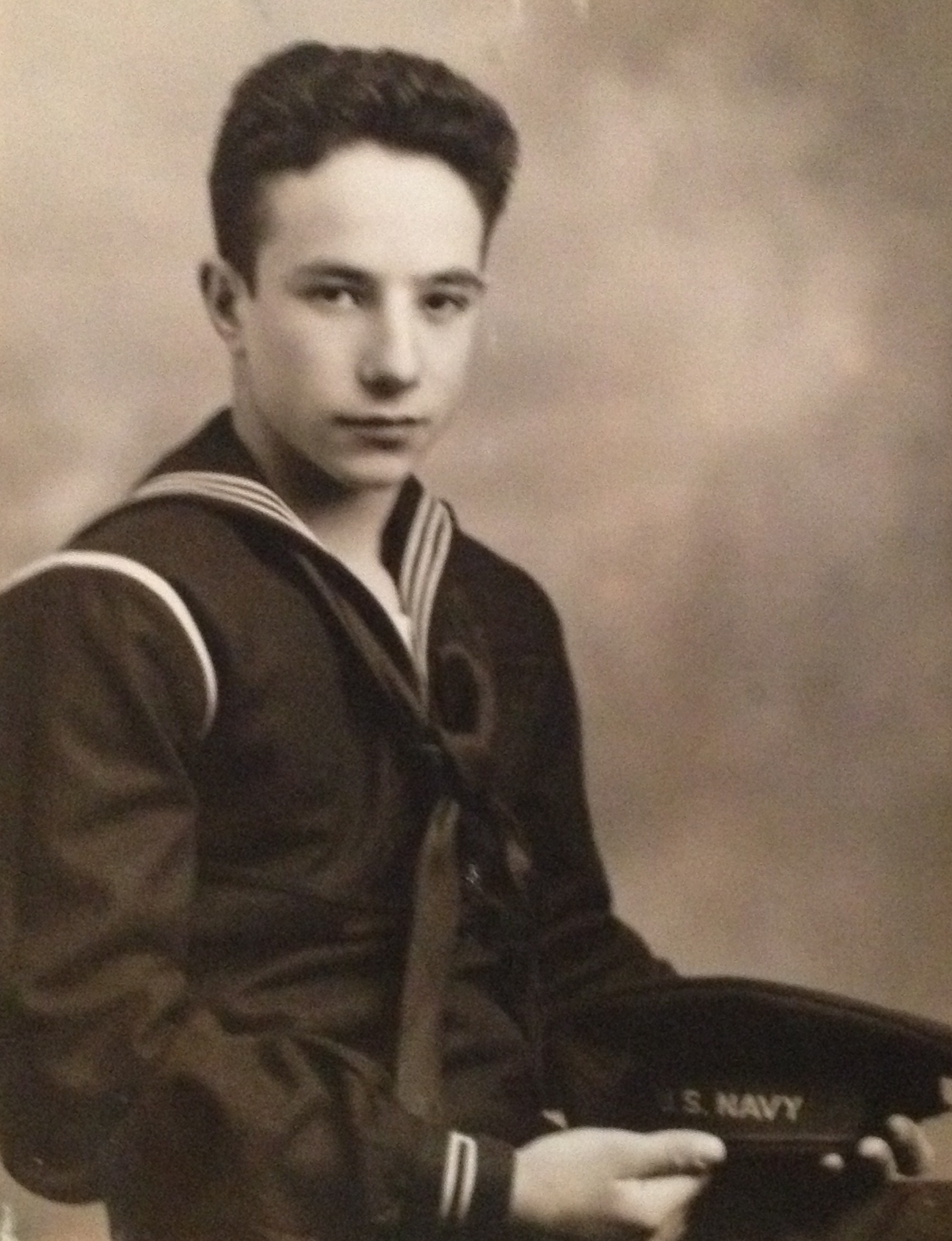
Each November 11th, I’d think about my grandfather Joe, a World War II Navy Veteran.

The thought was typically followed by an appreciative email or indebted Facebook post.  Some years I’d even make the old fashioned phone call.  Soon distracted by child rearing logistics and household priorities, I’d call it a day and opt out of making the 45 minute drive to pay a visit.

This time however, I had left Skootch’s red accordion at Joe’s house a few days before and much to the child’s dismay, had only the purple one at home.  So in an effort to temper a peppering five year old, the boys and I piled into the Outback and joined my grandfather for lunch.

Joe greeted his great-grandsons at the door, offered respective kisses, and held them on the landing.

“Did you see my American flag?” he asked.

It was no surprise and nice to see that despite having recently lost his wife of 65 years, Joe remembered to dress the pole he had raised between a patch of hedges adjacent to the front stoop to commemorate the holiday and a defining time in his life.

“Do you know how to do a soldier’s salute?”

My grandfather faced the flag, modeled the salute, and instructed the boys to pay the toll.  “Now you do it.”

Bubbe smiled shyly and gave it a go.  The Skootch puffed his chest, cupped his palm and looked at it.  Joe helped the effort along.  The group crossed the threshold and stopped in the front hall.

“Do you fly one at home?” he asked.  Joe didn’t wait for an answer.  “Here take these.”  He snatched a pair of parade flags from a collection stored in a nearby bucket.

The Skootch marched up to the second floor apartment, waving his new toy.  The parade was short lived.  Toddler sized penguins and a Santa Claus were performing center stage in the living room.  He dropped the flag.

My grandfather rescued it.  “No.  Never let it touch the ground.  Out of respect and honor, the American flag should always point toward the sky,” he explained.  “Let’s put it in a safe place.”  He tucked the base into a puffy coat curled up on a Captain’s chair.

Bubbe followed suit; partially to secure the flag but mostly to search for his great-grandpa’s Kindle Fire and Oreos in a nearby hutch.

On route to the cookies, he noticed a glass display case perched near the front of the hutch shelf.  It was filled with mounted, decorated ribbons laid out like a Holland tulip field.

“What are these?”  Bubbe wiped away the dust.

“Those are my war medals,” Joe said and went on to explain them one by one.

“American Campaign…

European, African, Middle Eastern Campaign…2 bronze stars

Asiatic, Pacific Campaign…2 bronze stars”

There were six in total.  He circled back to the top row.  “These are my dog tags.  I wore them around my neck the entire time I was away.  Do you know why soldiers wear two tags?”

“No,” Bubbe said.

“If a solider dies, one stays on the body; the other gets sent home.”

“Oh.  I get it.”

Eavesdropping from the kitchen I thought,

Will he ever really get it? 

When my children are grown, what will service, sacrifice, and country mean to them?

It is wonderful that we have a proud, willing veteran in our family to share experiences but unfortunately, I can count on one hand the number of service men and women we know.  Outside of my grandfather, Bubbe and The Skootch have had only the opportunity to interact with veterans or those in active duty during elementary and religious school programs.  And as Op-Ed columnist, Maureen Dowd recently noted, with “one percent of the population voluntarily enlisting in the service,” it is likely that in the future, my boys will be exposed more regularly to comic book heroes than to everyday ones.

Thankfully sacrifice, service, character, and citizenship are still being communicated in schools, through extra-curricular activities, at houses of worship and in our homes.  Still, teaching young people the value of contributing to the greater good feels piecemealed, fit in, and a vehicle for resume padding.

The potential for further disconnect in these formal settings seems imminent now that such lessons are being muscled from the spotlight by college, career readiness, English Language Arts requirements and STEM.  In my state, there is even a motion to de-emphasize Social Studies.

Israeli citizens get it.  Out of necessity, conscription exists for most of the country’s Jewish Israeli population.  Upon turning 18, men and women are obligated to serve in the military for three and two years, respectively.  As a result, my 65 year old friend can relate directly to the experiences of an active soldier as well as identify with the five year old who knows he will one day fill those shoes.  There, generations of citizens connect through collective responsibility and common experience.

In 2010, my husband Mac’s Letter to the Editor was published in The New York Times in response to the article, “The Way We Treat Our Troops” which in part offered support for a mandatory draft.  The guy was onto something.  He wrote:

“If the good problem arises where we have an abundance of young people in the military during peacetime, they could be deployed toward other national services like helping the elderly, the indigent and the disabled or for cleanup after national disasters, mentoring children and so on.  America is a terrific place to live; if young people gave something back and worked alongside other Americans from all walks of life, it would tie us closer together as a country.”

In February 2013, New York State Congressman Charles Rangel introduced a most recent version of the Universal National Service Act to the House of Representative’s Armed Services Committee.

The bill requires all persons between the ages of 18 and 25 living in the United States, citizen or otherwise to perform two years of national uniformed or civilian service.  Those choosing uniformed service may also be inducted during wartime, a national emergency, or a contingency operation.  This CrossFit junkie would add that prior to selecting a service type; able-bodied participants attend basic training in cohorts.  There is something to be said for intense, group exercise.  It fosters camaraderie, physical and emotional growth, and team pride.

To date, the bill has not moved in Congress.

Yes.  I realize the devil is in the details and that bigger government doesn’t necessarily translate into better outcomes.  Yes.  We do have a responsibility to teach our children in our families and community about service, sacrifice, and selfless giving.  And yes, I too wonder about the mandatory component of such a program in a free society.

Regardless, I think it is time to take meaningful action.

Perhaps a national service requirement will shift expectations for and alleviate pressure on high school students, change the way the college admissions process is managed, reduce some of the direct financial burden on families trying to pay for higher education, and offer guidance for college graduates looking to take the next step.

More importantly, perhaps it will build awareness and understanding for soldiers and veterans suffering trauma, make care and reentry a priority for when they return home, and simply bring us closer as a nation.

“Our debt to the heroic men and valiant women

in the service of our country can never be repaid.

They have earned our undying gratitude.

America will never forget their sacrifices.”

-President Harry S Truman

There is a way to repay veterans like Joe.

Poppie in the navy

Let us step away from the sideline to work in tandem with those on the front line in an effort to strengthen and preserve the solidarity of an already great nation.

Let us pay the toll.

One, Lucky Granddaughter

Gram and me as a baby

Brain Child Logo

Mothering Mag logo

Two weeks ago, I lost my grandmother to cancer.  The disease engulfed Dot’s body almost as quickly as she learned the diagnosis.

When the doctors assured she still had a few weeks, I returned home, gathered my notebook, and made big plans to capture my grandmother’s talkative mood.

My mind raced with possibility; perhaps, as Jewish tradition teaches, Dot could fulfill the 613th mitzvah and write a Torah, a personal 10 commandments thus sealing her life scroll or perhaps, as a member of her church’s quilting guild she could share patch ideas for a memory quilt.

But by the time I got back to my grandmother’s bedside, she was already in a final sleep.  Weeks whittled to hours.  Before sunrise, she was gone.

Dot’s death was beautiful; swift, pain free, and at home surrounded by loved ones.  Her last days, passing, and funeral were a fluid waltz.  Everything fell into place as if she was the choreographer.

Without her words, I stretched my accordion memory file in search of tucked away treasures.  Two stepped forward; Sweet 16 and Oh Definitely.

Each birthday, my grandmother would caw over her candles, “I’m sweet sixteen and never been kissed.”  Sixteen was her forever age; the age at which she liked to see herself.

Pic of Gram sweet 16

Any time Dot emphatically agreed with a point, she broke her silence with a high pitched, “Oh, definitely!”

More memories began to surface.  My notebook soon filled to form Dot’s Sweet 16 of Definite-lys.

Definitely…

1.     Listen for understanding.  When conversing with others, don’t uh-huh, right, or yes them.  Take it all in.  Dot was everyone’s ear; mine included.

2.     Visit the sick.  My grandmother was not afraid to go into the fray.  She recognized that one’s comfort was more important than personal or situational anxiety.  The key to helping those failing feel alive, she recently told me, was to talk about old times.  Present day connections are less meaningful to a lost mind.

3.     Create a warm and inviting home.  Dot raised three daughters on the second floor of a modest, two-family house.  Even as the family grew, her apartment was the place to be; men congregated in the living room, ladies packed around the dining table.  A full home filled my grandmother’s heart.

4.     Keep an open door policy.  Dot always left an empty plate on the table.  Crowds of cousins, neighbors, and friends traipsed through the door in search of company and my grandmother’s eggplant parm, kielbasa, spareribs, and peanut brittle.  No appointment needed.  Guests knew when Dot’s Westminster doorbell chimed, she would welcome them.

5.     Talk to everyone and do it with respect and genuine interest.  My grandmother was well versed in the art of chit-chatting and boy, could she work a room.  From store clerks to politicians, children to commuters, she never categorized or judged.  In recent years, however, she became increasingly disillusioned with technology.  “No one stops to talk anymore,” she said.  It made her sad.

6.     Be a good time Charlie.  Cut a rug, laugh, quip, banter, sing.  Dot loved to tell tales of old boyfriends and reminisce about her young and single watering hole shenanigans.

Gram in curlers

7.     Send cards.  I’m convinced Dot single-handedly bankrolled Hallmark.  My grandmother sent a card to every grandchild, great-grandchild, in-law, daughter and cousin regardless of age for every birthday and holiday, Jewish, Christian, secular or otherwise.  Enclosed was always a personal check and for the little ones, an additional side of cash.  Relatives can’t help but smile when they talk about Dot’s cards.

8.     Watch your television stories, but limit the news; it is depressing and redundant.  When my grandmother told Mac she had to check into a quiet hospital room to escape Fox News, ISIS, and Ebola, he couldn’t help but laugh.

9.     Take advantage of an opportunity but own up to its responsibility.  My grandmother didn’t get her driver’s license until she was a mother of three in her thirties.  She loved to drive.  With a dashboard pat for luck and a tank that never fell below the half way mark, Dot was always on the go.  As her housemate until age five, I don’t remember ever being home before supper.  But when her eyes weakened a dozen years ago, she didn’t hesitate and returned the keys.

10.   Forge ahead.  My grandmother’s limited eyesight was exacerbated by arthritic knees, a temperamental heart, weekly doctor visits, and piles of medication.  Not once did she complain.

11.   Volunteer in your community, house of worship, schools or wherever floats your boat.  My grandmother’s obituary noted her occupation as Homemaker.  More so, she was a chauffeur, troop leader, lunchroom aide, caregiver, church elder, and neighborhood sentinel.  You name it, she did it because for her, the making of homes took a vested village.

12.    Say “I love you.”  Dot had a hard time doing this; showing love was easier.  The last time my grandmother heard me say I love you, she still flicked her wrist and squawked, “I know, I know,” trying desperately to fight the tears.

13.    Avoid self pity.  Dot was a Depression kid from a broken home who left school in the 10th grade.  These experiences never stopped her from embracing life.

14.    Communicate.  My grandmother didn’t speak to her sister for thirty years and regretted the lost time.  “Put all the cards on the table now,” she advised.  “Grudges are worthless.  Life is too short.”

15.    Keep the faith.  Dot had an unwavering commitment to prayer and church; attending and sharing a pew with the same senior ladies each Sunday, often offering the young ministers words of kindness and encouragement.  She held fast to what spoke to her in this universe and at the end, wasn’t afraid to let go.

16.    Love well.  During my grandmother’s final hours, her apartment was filled with family giving to her and my grandfather what she had always given to us: attention, care, support, strength, and comfort.  At her funeral, it was no surprise to hear that strangers approached my grandfather saying, “You don’t know me, but I knew Dot.  She was a special lady.”  My grandmother left an imprint on the hearts of many because above all things, she valued love.

Three days before Dot’s death, The Skootch said goodbye to his great-grandmother.

He stood at the base of the hospice bed and said, “I love you, G.G.”

“You do?” she replied.

“I will miss you when God comes.”

God came; all too soon and all too suddenly it seems and I miss her.

People speak of rocks; Dot was mine.  My grandmother was an exceptional lady who, during the era of her teenage crush, Frank Sinatra but long before Derek Jeter did things her way.

This way, her spirit, and legacy fill me today and always.

I am one, lucky granddaughter.

Most definitely.

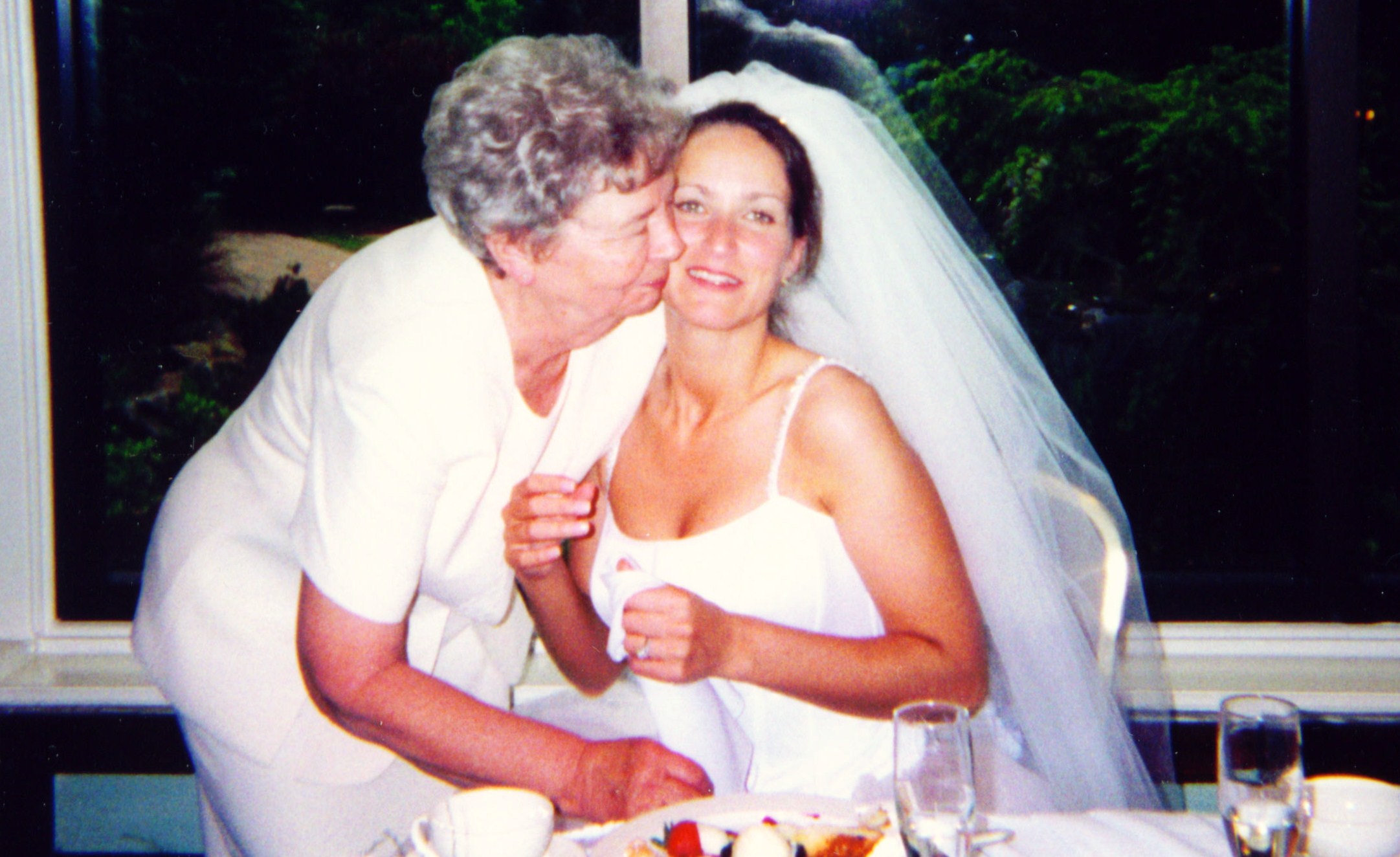
Gram and me wedding picture

Laundry Room Mishpacha; a Rosh Hashanah Tale

rosh hashanah image

InterFaithFamily picture

After Hurricane Sandy, roughly six weeks post Rosh Hashanah 2012, we temporarily moved into my in-laws’ apartment.  The building is home to a number of observant Jewish families, my in-laws included.

Waiting in the laundry room, I noticed a grandma folding clothes while her four-ish year old twin grandchildren, a boy and girl played nearby.

“I’m going to sing a Rosh Hashanah song,” announced the light eyed little guy.

After he got a few lines into his song I said, “That’s a nice tune.”

“He’s a good singer,” Grandma replied.

“Yes.  I haven’t heard that one before.”

Right then his sister whipped her auburn curls, looked me dead in the eye and declared, “That’s because you’re not Jewish.

“Watch what you say to people!” Grandma barked.

Watch what you teach her, I thought.

I bit my lip and explained, “The Rosh Hashanah song I know is different.  It goes like this…”

I sang a few lines of my holiday ditty.  Thankfully the dryer’s buzzer went off.  I took my clothes, wished them a good day and left – fuming.

Why do I have to be Jewish to know a Rosh Hashanah song?  Why did the girl assume I was different than she?  We were in the laundry room, not synagogue and it wasn’t Shabbat.  Could she really have drawn her conclusion simply because I was dressed less conservatively than her grandmother?

It wasn’t clear.

What was clear was this little girl had been taught either directly or indirectly to identify, judge, and draw a conclusion about a person based on one’s appearance relative to the other grown-ups in her life.  As a Christian woman married to a Jewish man who takes pride in raising Jewish children, I felt offended and sad.

This week, my family will celebrate the Jewish New Year.  Rosh Hashanah and Yom Kippur are a time of reflection and new beginnings.  Whether you observe or not, perhaps it’s a good time for us to think about the symbolic gestures we feel bring us closer to God.  Although seemingly benign when practiced with a similar group, the question remains;

Do these gestures create an unhealthy divide, particularly when our children form false and hurtful conclusions based on them?

When all is said and done, I personally don’t think God gives a rat’s ass about what clothes we wore, the food we ate, the holidays we observed, or how many times a day we prayed.

It is how we view and treat each other while we are here that matters.

But let’s be realistic; life is wonderfully diverse and so our lifestyles will vary and symbols sustain.  So in an effort to close the gap, let’s be mindful about consistently teaching young people that all religious and cultural perspectives are valid and deserve respect.

Grandma, you and I may have different ways of approaching our day to day living, but my hope is that we embody the same values.  With this New Year upon us, let’s show our children that when we look beyond the laundry room, we are all mishpacha.

The Loss of a Therapist

I used to tell people I would never see a therapist.  Then my young marriage to Mac began to crumble.

Having spent a lifetime immersed in family dysfunction, crumbling traveled with me; gaps in the sidewalk were the norm and I was a comfortable expert at skirting them.  It was only when Mac and I tried and failed to get pregnant, and the reality of possibly never adding Mother to my resume sank in that my feet got caught up in the cracks.

Still, I refused therapy.  “We don’t need a shrink,” I told my husband.  “We can deal with problems on our own.  It’s not anyone else’s business.”

Frustrated and tired, Mac took himself to see Amy; a well regarded and highly recommended social worker who conveniently had a home office across town.

“She wants to meet both of us,” he said afterward.  “You need to go to a session so Amy can understand how to help.”

We’d been down the counseling road before, but this was the first time Mac actually met with a person. His suggestion was Amy’s request and there was no talking my way out of it.  With her involved, ignoring Mac’s plea translated into losing him, our marriage, and the prospect of starting a family.  Backed into a corner, I made the appointment.

Amy’s home office was on the second floor of her well kept Tudor style home.  Up a small set of stairs adjacent to the living room, it was a guest bedroom, library, TV room and therapy space rolled into one.  One wall was filled with a pale, but inviting sofa adorned with embroidered pillows partnered with a cubed pouf.  I shoved myself into its corner, scratching my back against the pillow stitching.  The balls of my feet pressed against the base of the cube.  There I sat, stiff with pride ready to convince her that I didn’t need help from any therapist.

Amy settled into an over-sized swivel chair across the room, slid off her flats, and rested a tiny pair of feet on a nearby stool.  Behind her sat a narrow desk flanked by impressively organized wall length shelves.  Magazines, photographs, Judaica, and a sculpture of a molar gave me a glimpse into her private life.   I stared beyond the chair hoping my fascination with the decor might deflect attention from me.  But to no avail; there she sat, petite, blonde, plump, suntanned, manicured and ready to listen.

“Why don’t you tell me about your background; your upbringing,” Amy suggested.

That’s all it took.  As a logical thinker, model student and frugal realist, I knew on some level it made sense to embrace this chance and bank on Amy’s expertise.  The clock was ticking, the check was written, so it was time.  Out it came; the family secret I had harbored for twenty-five years.  When the session was over I knew it was going to be the first of many.  That conversation commenced our eight year relationship.

Whenever we met, Amy escorted me from the front door to the office where I took the customary position.

Because she worked from home, she made it a point to conduct our sessions with arm’s-length professionalism.  Still, Amy managed to convey a maternal sensibility rooted in spirituality and common sense.  I quickly learned that she was a little lady with a powerful presence, a strong sense of justice and an unwavering conviction to improve the lives of others.

Amy always said the right words, gave effective homework, and provided the necessary tools to help me treat wounds, shed skin, and grow up.  Some weeks her office was a welcomed respite; other times a dreaded box.  Regardless, I always felt safe.  Over time, I joined the sofa’s center and let my heels crawl up the back of the ottoman.  Together we worked through my list:

Childhood trauma, abandonment, reconciliation…

Self worth, family, love, intimacy, marriage, faith

Career, pregnancy, birth, motherhood, betrayal …

Initially once a week, then every other; sometimes with Mac, sometimes alone that office, the list, and Amy’s guidance during those first years were a constant.  Inside that space, the only variable was the magazine covers.  Consequently, on the outside I got healthier, my marriage began to mend, and our family grew.

Needless to say, Amy and I had a good thing going.

During year five, things changed.

At the end of one session Amy casually announced, “Tomorrow I’m having a medical procedure.  I will not be working for awhile.”  She confidently handed over contact information for her back up therapist and reassured me she’d return.

Several weeks later, Amy and I reconvened.  I immediately noticed a shift in the tenor of our conversations.  Her approach, albeit professional was more direct.  She also began to sprinkle my therapy with an occasional personal anecdote.

Treatments followed the medical procedure.  Amy shared very little information; only that as a result, she might need to change our schedule.

For months, I sat on the couch and watched her deteriorate; plump shrunk to thin, her blonde hair faded, and the suntanned skin grayed.  Amy seemed tired but determined to live her life.

When her color came back and hair grew thick, Mac and I breathed a sigh of relief.  She shared that whatever growth she had was smaller, but required ongoing medication.  Amy sounded stronger and had a renewed outlook.

Two years and she never used the word cancer, but Mac and I knew.

Then Amy took a downturn; more treatments, more medication.  Each time I saw her, it felt as if she was fighting less for normalcy and more for life.  But because I was her client, our time together was focused on me.  She wanted it that way.  I was deeply concerned about her health but I let her do her job.  Amy wasn’t giving up on me, so I refused to give up on her.

One evening session, her office phone rang several times.  Amy uncharacteristically picked it up.  I noticed her elevated legs were bloated and swollen.

“I’m sorry,” she said.  “I thought it was the doctor’s office.  Let’s continue…”

When time was up, Amy paused for a moment; long enough for me to believe she was debating her thoughts.  Then she asked the usual question, “Do you want to schedule an appointment now?”

“No, I’m going on vacation,” I reminded her.  “I’ll call you when I get back.”

She walked me down the stairs to the door.  “So we’ll plan to meet in two weeks?”

“Yes.”  Then I said something I got used to not saying, “Thank you, Amy.”

Two weeks later, I went back to her house.  This time, I let myself in; I didn’t go upstairs.  Instead, I joined a group of familiar faces on low, hard, black leather chairs.  I kept my feet firmly planted on the living room rug, hands clasped in my lap.  The faces were Amy’s family.  I was paying a Shiva call.

I listened to her adoring husband share his memories, watched her devoted son, daughter, and pregnant daughter-in-law keep busy, and smiled at her spirited grandchildren as they played on the stairs, disappearing into the office.  These people were no longer the characters in Amy’s anecdotes, the aging images in her photographs, and the fairies that left toy remnants on the rug.  They were real people who lost a cherished loved and I felt sad for their devastating loss.

But it was my loss too.  I was there to pay condolences, but needed some of my own.  Yes, my relationship with Amy was professional; it was also intimate and sacred.  Even though I needed to mourn the loss of my therapist, I resisted the urge.  “Amy was not family or friend,” I thought, “It’s not my place to grieve this woman.”  Surrounded by those closest to her, I felt guilty and unworthy of sympathy.

I soon realized that it was okay to grieve, just not right then.  I spent close to a decade healing in that house but now Amy’s home was no longer my therapy place, and her husband and children were not the ones to console me.  It was again time; to turn inward to my tools and outward to my loved ones.  My work with Amy was done.  I was ready.

As I left, Amy’s husband and I exchanged a knowing glance, smiled and said, “Stay well.”

It has been years since Amy passed away.  Larry and I sometimes talk about her when we have an issue, need to reflect, or feel sad she’s not here.

Recently, we were recalling Amy’s modestly attended funeral.  She was our rock star.  Her work changed my life and saved our marriage.  It will have an impact on us, our children, and family for generations.

“Why wasn’t there a line of mourners spilling from the sanctuary?” I asked.  “Where were all her other fans that day?”

Then Larry reminded me, “Amy was an ordinary lady who happened to do extraordinary work.  She was the best kind of person.”

He was right.  For that, I am grateful.