Two Sides of a Coin

Beach picture of the boys

Bubbe and The Skootch are two sides of a coin.

Bubbe, now a smidge under nine was the two year old who got off the classroom rug at dismissal only after he knew the other children had a place to go and the little guy who sat in the corner and covered his ears at birthday parties.  He is the child who relishes in engineering golf courses and marble runs out of anything he can get his hands on and the boy who recently told me after I advised him to push back as needed, “Mom, I’m not that kind of kid.”

Four year old Skootch, on the other hand, is a one speed, rock and roll, let me smell you ninja machine.  He is the kid who proudly wakes his parents at two in the morning to show us the late night grape juice he poured for himself, the child who sings loudest at birthday parties, the one who pops a balloon and tries to fix it, and the boy who loves a good boxing match.

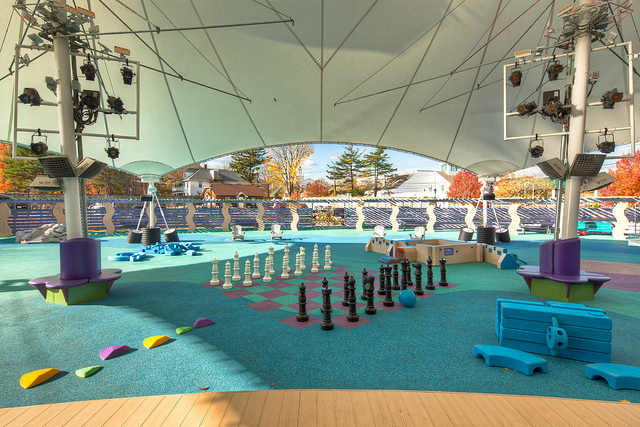
On a recent family outing, we found ourselves here;
stepping_stones_museum_children

The Celebration Courtyard of a nearby children’s museum.

I’m pretty certain this foamy, cerulean hued open play area is meant to encourage calm but on this particular Saturday it looked more like a loony bin for babes.

Bubbe naturally made a beeline for the blocks.  Swarms of children surrounded the construction materials, moving in and out, taking them at will.  He tried to grab what he could, but the other children kept getting there first.

The biggest boy of the bunch became a regular culprit.  Not a caregiver in sight, this young Lummox grabbed at our son’s small stash again and again without so much as asking.

Bubbe began to hold his temples in distress; his thoughts piercing the cerulean calm.  “What am I going to do; how am I going to manage this problem?”  Thirty seconds of frozen agony seemed like a lifetime for the poor boy.

Our golden-haired fire hydrant watched Bubbe desperately trying to get his bearings, sensed the angst, and swooped in for the rescue.  He marched right up to the Lummox who was twice his size, waved a southpaw, pudgy finger up at him and yelled, “Hey this is our space and you don’t take anything from here!”  Then he stepped in and offered a right hook.

The Lummox jumped back, recoiled, and found a new space from whence to steal.

As soon as The Skootch was confident that Bubbe’s artistic space was clear and safe, he asked his brother, “Ok, now what?”

Bubbe gave the order.  “Go get a couple of blocks.”

“Alright,” The Skootch scurried off and successfully returned with the coveted blue, foamed mass.

For a serious ten minutes, Bubbe constructed and sent The Skootch into the wild as the little boy happily obliged his big brother’s instructions.

Together they created quite the structure.

Too pooped to pop, Skootch lied down in the center of the masterpiece.  “Thank you for building my castle,” he said.

“You’re welcome,” Bubbe replied.

We never expected to have two children; Mac and I were content with one, healthy Bubbe.  The Skootch was a happy accident.  We wouldn’t have it any other way.  Our sons, these brothers, are a gift; to us and to each other.

They are most certainly two sides of a coin, but together their value is immeasurable.

Six ways to 65 years; Relationship Advice from a Platinum Couple

Grandparents' wedding picture

At my grandparents’ golden wedding anniversary party, my new fiancé, Mac gave an impromptu toast to the happy couple.  Fifteen years later, we never imagined we would once again be celebrating with Joe and Dot for their 65th anniversary.  Last month, we were lucky enough to do just that.

My grandparents are part of The Greatest Generation.

He, a World War II Navy veteran saw The Battle of Normandy in the Atlantic, Okinawa in the Pacific, and lost his parents and almost his own life in a tragic accident all before the age of twenty-one.  A devoted husband and well-meaning father with a strong work ethic who can fix anything, Joe greets life with a smile.  My grandfather is a youthful, spirited song and dance man, musician and opera lover who has serenaded and entertained generations of children.

She, a family and community matriarch who experienced divorce, fierce sibling rivalry, and an alcoholic, estranged father during her youth is a compassionate but no nonsense lady with strong opinions who keeps emotions close to the vest.  A church elder, domestic financier, caregiver, therapist, hostess, Frank Sinatra enthusiast and rabble rouser, Dot has raised, fed, housed, guided and knit elaborate sweaters for generations of children.

Joe and Dot are salt of the earth folk who grew up only a few miles from each other.  They met at work after the war, fell in love and married in four short months.  In their hometown, they raised three children in a modest, two-family house where they still live today.  Now in their late eighties, while the rest of us are busy reading up on which way to lean, they are quietly leaning on each other; much more now it seems than days long ago.

Grandparents 65th anniversary picture

And so with sixty-five years of couple hood under their belt, I asked my grandparents to share six pieces of relationship advice, one for each decade of marriage.  Here is what they had to say:

  1. Have your own friends, take time to socialize individually with them, and be supportive when your partner does as well.  Trust each other; jealousy is not love.
  1. Swallow your pride.  Even when you know you’re in the right; let your partner think he is the right one every now and again.
  1. Let the person who is committed to and better at saving money be in charge of the finances.  Then try and save as much as you can.
  1. Life is a bowl of cherries; some picks are sweet, others rotten.  Always try to keep a cool, level head when snacking.
  1. Sing to your child if you have one, especially as he awakes in the morning.  If singing isn’t for you, create a daily ritual; he will always remember it.  And when your child does something wrong, don’t always tell your partner.  Sometimes too many cooks in the kitchen complicate things.  Work it out one on one with your kid; he’ll remember that too.
  1. At the day’s end, take time to decompress and give your partner time to do the same.  Be thoughtful and aide the process; have a cocktail ready for her when she gets home from work.

6 ½.   Follow your heart, stand by your love, and keep promises to each other.  If you have second thoughts or believe you can’t keep your word, don’t get married.

As the eldest grandchild who lived with them until I was five and then again at twenty-two with countless visits in between and thereafter, I had a ringside seat to much of Joe and Dot’s relationship.  My take away from watching them?

Flirt, dance, sit outside, visit, celebrate, play cards, laugh, argue, reconcile.  Life is a fast and fleeting ride so keep the relationship as interesting as you collectively see fit and be sure to have a good time.

Couple hood is complicated work; everybody has their stuff and it’s not all moonlight and canoes.  But if you go by Joe and Dot, trust, compromise, balance, communication, support, love, honesty, commitment, cocktails and a song go a long way.

Gram and Pop dancing

The Hovel

cherry blossom tree pic

Here in the Northeast, the mourning doves are cooing again.  The sound reminds me of the spring I was pregnant with my first son.  That year, a couple built a nest in a cherry blossom tree outside the window of our soon to be nursery.  When we brought him home from the hospital, two eggs hatched from the nest.  The family took a liking to our Urb-Burb neighborhood and set up permanent residence.

Each season, after the first buds appeared my son, Bubbe and I would sit in his rocker, peer down onto the pink and red blossoms, and watch for the doves.  When the birds returned, much like my growing boy, they were a little bigger, bolder, and wiser.  Our rocker time evolved into a game of I Spy for him and a welcomed mother and son tradition for me.

This spring things are different.  One year ago our family said goodbye to the doves, that glorious tree, and our home of two decades; The Hovel.

The Hovel was originally my husband’s place.  Mac purchased the quaint, turn of the century Victorian style house in the late eighties using money his father had left him in his will.

For a dozen years, he rented out spare bedrooms to supplement mortgage payments to, as a friend described, “a parade of cretins.”  Rock stars, sparrow heads, and a couple of regular guys made up the crew.  Together they enjoyed poker games, Tyson fights, dates, beer, and general shenanigans.  It was good fraternity house fun.

Around the time Y2K threatened to destroy our technological way of life, domesticity disrupted The Hovel’s rhythm.  I moved in.  Newly engaged, moderately enthusiastic, and abundantly neurotic I immediately commenced The Hovel’s fumigation.

Curtains went up.  Neighbors took notice.  The family to our right, who had yet to acknowledge my husband, invited us to go for ice cream.  When I planted flowers in the front yard, the elderly lady across the street yelled, “It’s about time!”  And after single handedly de-jungling overgrowth that swallowed the side yard, the father to our left said, “Whatta ya know, you have nice property.”

My newly betrothed begrudgingly went along for the ride.  Mac eventually got over the domestication hype; but so did I.  As projects piled up, responsibilities ensued, and my husband’s stubborn connection to The Hovel became evident, my enthusiasm waned.  I wanted out.

Then Bubbe was born, followed a few years later by The Skootch.  Our children breathed life into The Hovel.  She started to feel more like home.

But as they grew, her quaintness became claustrophobic.  I felt burdened by the upgrades and upkeep.  I wanted out again.  Each time I suggested a move Mac repeated the mantra, “People live with less.  We know what we have.  It’s a good house.”  I cursed him and The Hovel.  He was gum stuck in a sneaker groove and I resented it.

Well into my seventh year of scraping, Mac finally caved when my tune changed from lack of space to lack of confidence in the schools.  We prepared the house and put her on the market.  Two weeks later I received a new lease on life; The Hovel sold.

The evening before we closed, I stopped by to finish cleaning.  Our home stood empty; a hollowed, lifeless shell.  I went up to the nursery, looked out the window and for the first time, cried at the thought of losing her.

Too sad, I avoided that Urb-Burb neighborhood until recently when I had to pick up a package that was accidentally delivered to The Hovel.  The new owner offered to give me a tour.

With the exception of a fresh coat of exterior paint, a stately historic house plaque, and some thoughtful, decorative touches the house was more or less the same.  My brain rewinded like a mixed tape of greatest hits.

There was the living room; home to cushion forts, flying sessions, and makeshift mini-golf holes.  The kitchen countertop where the boys took their first sponge baths and Bubbe sniffed spices, always tasting the cinnamon.  The familiar nicks in the floor cabinet that The Skootch emptied daily to make drum kits from pots and skillets.

We walked through the dining room that hosted two brises, several Seders, countless birthdays and our first Christmas tree, and across the pine wood floor where my little guy took his first bowlegged steps.

I peeked in the narrow, upstairs bathroom where the boys innocently called from the window to their friends below to let them know they were out of the bath and naked, stepped around the iron floor registers whose ducts no doubt still housed my big guy’s marble collection, and admired the dent in the attic carpet where his bed once stood.

Outside, I gazed at the corner of the driveway where Bubbe and The Skootch shot hoops with Mac and smiled at the garden hose that fed a cascading irrigation system that always seemed to run long after I told the boys to stop wasting water.

The owner and I said our goodbyes at my favorite place, the front porch, where Mac and I spent endless evenings just trying to figure it all out.

It was strange to be in a space that I knew intimately, looked similar, still felt a connection with but knew didn’t belong to me.

But it was okay.

It was okay to mourn the loss of my house.  The lack of the tangible did not erase the intangible.  I no longer have the setting, but I still have my stories.  Thankfully, those memories will live for as long as my brain allows.

Leaving The Hovel behind was not a sad occasion but a passing of the torch.  She will always be the first home Mac and I made; the place where our children spent their first night after coming home from the hospital, and the place where we loved, laughed, grew, built friendships, and became a family.

To the new owners; as you welcome your newest addition this spring, keep an eye out for those doves.  Embrace the blossoms.  Write your stories.  Cherish your memories.  Love The Hovel.

We know you’ll take good care of her.

A Letter to My Palestinian-American Muslim Friend

Martin Luther King Jr Quote

ML_published_badge_red_Mamalode Voice of the Year BadgeWriters Digest 2015 BadgeHuffPost Religion Badge

Dear Friend,

Thank you for introducing yourself to me on the school yard when I was new to the community.  Had you not, I don’t know if I would have extended a hand.

When I initially saw you in the neighborhood, I avoided eye contact.  I couldn’t see passed the hijab. Your headscarf represented to me a religion of negativism and extremes, a culture of anti-Semitism, and a stifling of the modern woman.  I passed judgment, was ignorant and afraid.  I quickly concluded that we were from different worlds, and hence unable to find common ground; until we did.

Our sons’ fast friendship, much to my surprise, led to ours.  Several conversations, a few CrossFit WODs, and a shared hookah later, I learned some things.

First, your commitment to Islam is rooted in a spirituality that transcends all religions.

When I recently asked, “What did you learn from making pilgrimage to Mecca?” you shared with me along with the young people at the local mosque that in light of the experience, both positive and negative, you returned grateful for the gifts God gives us as free, healthy human beings and with an understanding that He loves us, imperfections and all.

At home, modesty, daily prayer, study, and diet are the tangible rituals you choose to demonstrate your love for God, but that love is also deeply evident in the thoughtful way in which you respect yourself, interact with others, approach parenting, nurture relationships, and care for patients.

Your words and actions remind me that we are all connected; Muslim, Christian, Jewish or otherwise.

Second, you have an open, accepting, and generous heart.

As a Christian woman raising Jewish children married to a man with a strong connection to Israel, I was worried that friendship might be tricky.  I was wrong.

From day one, you welcomed my family into your home.  You share your culture, answer questions, appreciate our traditions, and join us for holidays.  When my son swallowed a marble, you were at my door despite having worked a full day to help out and offer advice.  When I had jury duty, you spent the afternoon with my boys even though your children had busy schedules of their own.  You think of my family whenever you cook or travel, and thanks to your charming sweet tooth, my children affectionately refer to you as, “The Candy Fairy.”

The goodness that emanates from you inspires me to be better.

Third, you are an advocate for women; a role model for your son and daughters.

Your dress might be traditional, but your ideas and actions are progressive, willful, and strong.  I was moved when in an effort to understand practices, question inequities and evoke change, you approached Muslim women in the streets of Mecca and asked how they felt wearing a khimar, a long garment covering their head, neck, and shoulders, ran errands in pants to encourage dialogue, and questioned local leaders about the sanitation of the city.

Every day I watch you work tirelessly to support your family, use your education to help others, handle conflict and struggle with grace and perseverance, tackle new adventures with uncanny energy, act zany, be fun, and simply love life.

You are an exemplary, modern American woman who I am proud to call my friend.

Connection and communication helped me to confront prejudice, challenge stereotypes, and understand a culture that I knew only through media, politics and hearsay.  I have renewed hope for future generations when I see our sons playing, laughing, and treating each other as brothers.

The hijab is not a symbol, but a frame; for the beautiful person you are outside and within.

Much love,

Red

2015 BlogHer Voice of the Year Reception

2015 BlogHer Voice of the Year Reception

Define Interesting

Richard Scarry Busytown

Life in urban suburbia is all amped up.

Working, parenting, schlepping, socializing, shopping, exercising, creating, competing, volunteering, networking, hiring, reinventing, and renovating; we residents don’t quit.  At any given moment, look above the head of the person in the crosswalk or the parent at school drop off and you’ll see a swirling cloud of thoughts polluting the air.

From nannies and nursery schools, tennis and travel teams, hot yoga and country clubs, the café with the best salad and the coffee house with the best scene to dinner parties and day camp, cliques and careers, book clubs and PTAs, local arts and big city connections, even casual conversation at the playground feels wired and burdened by the need for it to be about something.

I liken this way of life to Richard Scary’s, What Do People Do All Day? Just slap some riding boots on Lowly worm, switch out Mr. Frumble’s bananamobile for a luxury SUV, and squeeze Mommy Cat into a pair of Lululemons , and you have it; the Urb-Burb version of Busytown.

Where everybody is looking good; doing something; being interesting.

So when some Urb-Burb families take a vacation, the getaway destination becomes increasingly attractive if the activities and environment is simplified, back to basic, and dare I say, normal.

One day, I was chatting with a couple from the community about summer family vacations. They were gushing about a country retreat that they and their children take every year.

I grew up in the country and my husband likes anything rural, so I was excited to learn more. “What’s it like?” I asked.

“It’s a great place to visit,” the wife explained. “Nothing too fancy, very low key, with activities for everyone. Plus the same families try and go back the same week each summer, so you really get to know people.” Then with her face as serious as stone she said it, “Interesting people, too.”

“Interesting people? What the hell does that mean?” I thought.

This wasn’t the first time I’d heard the term, Interesting People used as a qualifier. Tongue tied, I didn’t ask what she meant. Instead, I cocked my head and gave a standard Urb-Burb response, “Aah, is that right?”

Let’s define interesting. What attracts you to a person that makes you want to learn more?

Is it financial success, formal education, knowledge of the arts, volunteer efforts, travel experience, fashion style, dedication to the environment, fitness regime, family background, social prowess, or whatever the local majority decides?

If so, then we’re too caught up in our busy towns, swirling clouds, and skinny jeans to realize that we are missing the mark.

Interesting is found on the inside. It is goodness, generosity of spirit, integrity, courage, decency, positive intention, and kindness. And our communities, Urb-Burb or otherwise are teeming with people just like this.

Unfortunately, interesting is not always easy to see. It requires us to go below the surface, strip away insecurities, dial it down, stop trying so hard, extinguish formalities, examine priorities and perceptions, reach out, branch out, and be inclusive.

And that’s scary.

With October on the horizon, it is safe to say that we are back to the usual routine and are out and about in the community. So the next time you’re waiting to cross the street, buying time at the swings, or kicking back at that café try taking a page out of a preschool handbook.

Stop. Look. Listen. And then talk to someone.

Perhaps then we’ll begin to appreciate that everyone is interesting.