What’s Your Story?

Small world sign

Mac leaned across the handrail to get the lay of the ride’s land as he commentated into the iPhone.  “The happiest cruise that ever sailed.  It’s a Small World is the only thing I remember about my first trip to Disneyland, and I remember everything about it.  Even the boats are the same.  That was 1968.”

My wide-eyed husband entertained our boys with his broadcast as we herded our way around the corral, down to dockside, and into holding pen number three.  Mere seconds passed before our craft expeditiously floated into place.  We boarded, sitting four across in the center row: Me, five-year old Skootch, big brother Bubbe and Mac.

“Mom and Dad, there are 16 in the boat.”  A divine voice with an undertone of Disney princess addressed the crowd from a microphone equip cotton candy hued canopied chair perched above our heads.

Our crew patiently waited for the boat in front of us to move.

It didn’t.

The Divine Princess spoke again.  “Sit the child on your lap so there are only 15 in the seats.”

As I thought, Who is she talking to? my quads seized, chest blotched, and shoulders went stiff.

Oh crap! She means us. 

The disembarking Happy Boats stacked up behind ours while lines of guests stared us down in the midday sun.

“Take him,” I ordered Mac.  He reached across and hoisted Skootch up.

“I want to sit next to Mom!”  Our brawny boy wrestled his way off of Mac’s lap, knocked into his brother who fell into me.  The ride rocked.  Passengers braced.

“Leave the boat,” I instructed my husband.  Mac returned to the dock to await the next cruise.

I counted fifteen passengers.  Problem solved.

“All four of you get off and wait,” the princess summoned.  “I said all four.”

“No!  I want this boat!” snapped Skootch.

I shooed Bubbe to shore and stepped over my stuck puppy hoping his fear of abandonment would set in.

It did.

“Okay Okay I’m coming,” he said.

Back in pen three, I stared at the concrete, gripping my boys’ hands for moral grounding until the new boat slipped into place.

Again, we sat four across.

Still displeased, the Divine Princess made a final pronouncement.  “Sit two and two.”

Mac and Bubbe moved up a row.  Skootch stayed with me for safekeeping.

At long last, the happiest cruise set sail.

Small world boat

Serenaded by the world’s children, our shipmates marveled at the unfolding spectacle in Mandarin, German, and English as we drifted through the tunnel.

Skootch hardly cracked a smile.

He skeptically squinted at Alice

Small world Europe

and curiously cocked his keppe at the carpets overhead.

it's a small world

Jiggled ever so slightly to the jarabe
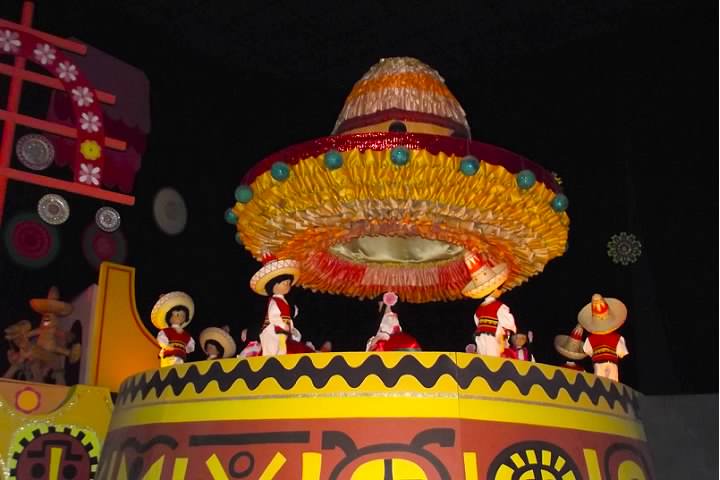
Small world South America

and silently shimmied his way through the South Pacific.

Small world, south pacific

It wasn’t’ until Skootch was embraced by a chorus of children adorned in white and gold that he completely settled into the experience.
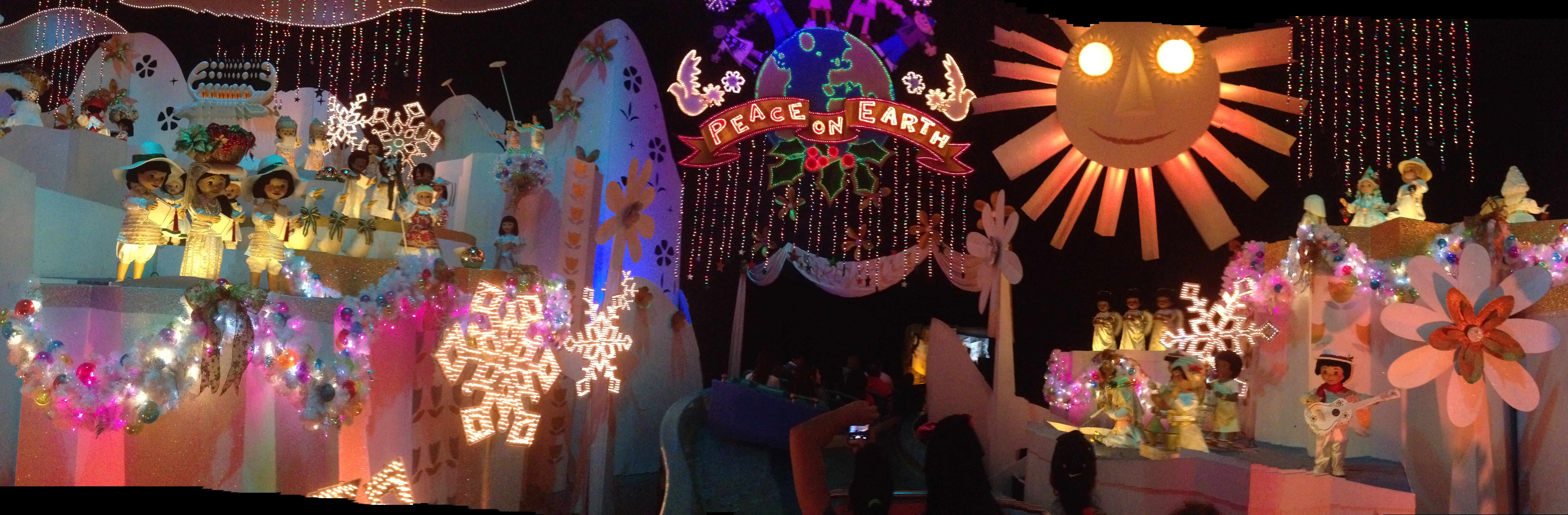
Small world finale picture

Our exiting vessel halted just shy of the Divine Princess’s throne.  “So what did you think?” I asked.

My son looked up with a cheeky grin and sang,

It’s a small world after all.

When Disneyland celebrates its 100th anniversary, perhaps Skootch will be the father leaning over the handrail recording into a device.

“The happiest cruise that ever sailed.  It’s a Small World is the only thing I remember about my first trip to Disneyland, and I remember everything about it.  Even the boats are the same.  That was 2015.

Kids, let me tell you something.  This small world is filled with harmony, variety, and life.  But if you truly want to enjoy the ride, sometimes you have to heed a higher voice, leave Mommy’s lap, and switch boats.”

On a recent visit out west, we squeezed in our first family trip to Disneyland between the measles outbreak and the park’s 60th anniversary.  Recalling our Small World experience at a Passover Seder, we were surprised to hear how many guests could relate.  From getting kicked out of a park for mischievous mischief to being trapped on It’s a Small World, it seems everyone had a Disney story.  This one is ours.

HOW TO RAISE BENEVOLENT DICTATORS SAID WHAT?…“The Importance of Lying About Food.”

'Mommy has made this astonishing cake just to get you to eat your peas and provide valuable insight for your therapist in twenty years.'

‘Mommy has made this astonishing cake just to get you to eat your peas and provide valuable insight for your therapist in twenty years.’

I recently read an article that appeared on The Mid and Huffington Post Parents called, “Six Words That Will End Picky Eating.” The author offered a sensible approach to reigning in the habits of sensitive eaters. I was pleased to learn that I was on the right track with my child and his persnickety palate.

Later the same day, I read the below article, “The Importance of Lying about Food” and I thought, now that’s more like it.

Common Core Testing; My Case for Opting In

IMG_4091

Let us all breathe a collective sigh of relief.

The 3rd-8th grade English Language Arts (ELA) and Math Common Core standardized tests are over.  You know the ones; the high-stake assessments pitched by politicians as guaranteed to close the achievement gap, ensure children are college and career ready, monitor the health of school districts and in my state, dictate the quality of teacher instruction.

Ten years ago, as a fourth grade teacher, I had the experience of administering and grading the state ELA and Math tests under No Child Left Behind in the same school my children attend today.

In April, my third grader took the Common Core version for the first time.

Many of his peers and an estimated 15% of children statewide did not.

Their parents “Opted Out.”

Those who joined the Opt Out Movement poignantly expressed concern citing that the current, mandated state assessments cripple public education, compromise the professionalism of teachers, steer time away from creative, meaningful curriculum, suck the joy from learning, and kill young spirits with its developmentally and grade level inappropriate language and length.

Despite the fact that I agree with these points, am a vocal supporter of education historian and activist Diane Ravitch’s platform, and believe the assessments in their existing form offer no diagnostic value for teacher or student,

I Opted In.

It was not because I’m worried about a potential loss of district funding or the perceived reputation of my son’s school, nor was it because I’m a data hungry mama on a mission to mold my child into an international marketplace competitor.

Truthfully, if I felt his learning needs weren’t being addressed, I may not have exposed him to a testing environment that requires nine year olds to sit several hours over a 3-day period for two consecutive weeks answering sophisticated and language heavy reading, writing, and math questions.  Furthermore, if my school district had Opted Out, I would have obliged.

As a public school student, my son is automatically a pawn in the conundrum of educational reform; ammunition in a grown up battle.

But he doesn’t know it.  And that’s good.

He is fortunate to attend a child-centered school that takes pride in their general, special, character, and arts education programs.  Inside the classroom, teachers do their best to thoughtfully integrate test prep into an already rich curriculum.  Since state testing commenced 15 years ago, the school district has stood behind their mantra; standardized assessments are a snapshot in a child’s day.

Buzz does not exist.

Outside the school, administrators voice concern about high-stakes testing and its implications in the local newspaper.  Board members write letters to the Board of Regents seeking change and travel to the state capital to fight for school district rights, standing firm outside the Chairman of Education Committee’s office until the senator answers their questions.

Advocacy is a priority.

Out of respect for my son’s innocence, love for his teacher and community, our leaders’ efforts, and in keeping with the belief that anxiety breeds anxiety, I don’t express my Common Core testing distaste at home and I don’t initiate conversation with my child about the “big state test.”

He knows it’s happening.

Had I Opted Out, my son would not only know it is happening, but also be acutely aware that he is concretely, conspicuously stuck in the middle of a movement that effects the quality of his education and the future of his teacher’s job.

And in my opinion, a nine year old does not need this additional burden thrown upon his shoulders.

So like the time he fell off the playground swing and looked to my reaction for his, I bit my lip and played it cool as the test date approached.  I made absolute sure he had a decent night’s sleep the nights before each assessment, breakfast in his belly the morning of, and plenty of down time in between.

As such, when he came home after the first day of the English Language Arts test, this is what he told me…

“Today was the big state test.  The teacher put our desks in a line, the old-fashioned way so we could have space.  She gave us gum to help us focus.  I didn’t like the flavor so I didn’t have any.  We took the test for about an hour.  Then we got two recesses.  During one of them, I played Knock Out and took second place against a 4th grader.  We don’t have any homework; I have no idea why, but we don’t.  It was a great day.  Can I have a snack?”

My response? “Good for you.”  I did not ask test specifics, how he worked, whether or not he finished, or how he performed. “Yes, help yourself.”

The morning of the Math test a week later, his primary concern was to make sure he packed orange flavored Life Savers in his backpack.

“Mom, sucking on them helps me focus.  Plus I like to trade them with friends.”

“That makes sense,” I said.

The “Opt Out” or “Opt In” choice for the 2014-2015 school year has been made.

Now what?

I don’t believe the elimination of standardized testing is realistic and the likelihood that I will Opt Out my child next year is slim.  But I do believe a compromise is necessary.

Juan Gonzalez, journalist for the New York Daily News recently made this valid point,

“Back in 2009, the old state tests showed 77% of students statewide were proficient in English.  The next year, the pass level was raised and the proficiency percentage dropped to 57%.  A few years later, Albany introduced Common Core and the level plummeted even more; to 31% statewide.  Same children.  Same teachers.  Different test.”

Step One?  Reconstruct the test.

  • Decrease the length. Requiring nine year olds to sit for 60, 70, and 90 minute stretches will only demonstrate how a child performs when fatigued.
  • Make the reading passages grade level. This year, it was reported that at least one 3rd grade English Language Arts test passage registered at a 5th grade reading level.  The 6th grade test apparently included vocabulary that could stump a grown up.
  • Offer a combination of concrete and inference ELA questions as well as Math problems rooted in mathematical concepts void of unnecessary language. Children develop differently; some minds are not ready or grounded enough in the language to tackle a multitude of higher level thinking questions.
  • Reduce testing frequency. It is possible to monitor a child’s general academic progress without subjecting him to standardized assessments for 6 consecutive years.  As former President Bill Clinton quoted in The Washington Post, “I think doing one test in elementary school, one in the end of middle school and one before the end of high school is quite enough if you do it right.”

Do. It. Right.

By creating fair tests, maybe we can begin the return to a balanced educational landscape where standardized tests play a small and perhaps valuable role in shaping a young person’s school experience.

Those who support the Opt Out Movement have outlined their future demands to state government officials.  Let’s see what happens.

In the meantime, instead of having a casual conversation in town with a board member or reading articles about my district administration, I need to get proactive and stand alongside them outside that stubborn senator’s office.

But I’ll be sure to leave my son home; to play Knock Out with friends, sample Life Savers, and enjoy his final years in elementary school because that’s his job.

Advocating for a sensible public school education is mine.

Dear Mom…Please stop calling me Buddy

Dear Mom picture

Dear Mom,

Please stop calling me Buddy.  I don’t like it.

At first, I was afraid to say anything because you’ve used the nickname since I was little.  Now I’m 9 ½ and Buddy sounds weird.  It’s embarrassing.

I was also worried I would hurt your feelings.  You always seem so excited to call me Buddy.  I can tell it means a lot to you.  I think you think calling me Buddy automatically brings us closer together.

It really doesn’t.

I know you love me when you sing to me in the morning, sneak a hug and a kiss on the corner before school, helped me wash the toenail out of my eye after it shot up off the clipper, taught me how to follow my basketball shot, pay me allowance, cook me perfect pasta, and stay for a cuddle talk at tuck in.

Like you always say, “Actions speak louder than words.”

Another thing; why do you call me Buddy when you’re mad?  Buddies are supposed to make each other happy, but every time you say

“Shut the Wii U off now, Buddy.”

“It’s late, Buddy.  Go back to bed.”

“Buddy come on, you left the student planner in your desk, again?”

with a growl or snake-eyed glare, I only feel scared and to be honest, a little angry myself.  The whole thing doesn’t make sense.

Know what else?  I like my name.  I like when you say my name.  I remember the story of how I got it.  You decided in eighth grade that if you ever had a son you would name him after your grandfather.  And you did.  So why don’t you use it?  You wouldn’t like it very much if I called you Red instead of Mom.  That’s not respectful.

The definition of Buddy is “a close friend.”   For real.  I Googled it.

Mom, I have friends.  I wasn’t a natural at making friends, but you showed me how to introduce myself, share, and speak up.  And when I felt shy about joining classmates in the block center or had a hard time sitting at a crowded snack table in preschool, you got me a helper teacher.  Now I’m good.

William from the baby playgroup, the kids in my class, the boys I have snowball fights with on the walk home from school, and the guys from my team; these are my buddies.

The ladies you meet for lunch and a chit chat, Daddy on date night, and that funny guy who fist pumps and belly dances in an elf hat at CrossFit; those are your buddies.

Maybe when I’m in college or living in my own apartment we will be close friends.

Right now, I need you to be my mom.

So please stop saying Buddy.  I know it’s different and might be a tough habit to break, but you can handle it.

I Love You,

Your son

I never got into the habit of calling my children Buddy.  Bubbe, Big Guy, Skootch, Kiddo, and Bubbeleh yes; but never Buddy.  If I had, I hope that one of them would write me this letter.


The Day I Deleted Minecraft; a letter to my son

IMG_3911

ML_published_badge_red_Mamalode

For Every Mom badge   tpt-badge_contributor

Dear Bubbe,

I never intended to do it; really.  One second it was a quivering icon, the next it was gone.  Just. Like. Magic.

Honestly, it brought on a smile.  I’m not trying to be mean.  Chalk it up to a Mommy epiphany, a moment of clarity.  The day I deleted Minecraft, I liberated myself and you of a virtual, addictive burden.  Pressing that shaky, little X ushered you back to real life.  That made me happy.

In the beginning, I was a fan.

Compared to the other choices the video game world has to offer, I could see why you wanted to tap the piggy bank to invest in one that requires players to scavenge for resources, earn survival treasure, design landscapes, construct villages, and defend against intruders.  As a lifelong rock collector, forager of sorts, visual thinker, and creative designer it appealed to many of your natural sensibilities.

A popular topic of discussion at summer camp and later in the school cafeteria, Minecraft was also something to bond over with friends.  Game play and conversations led to art projects, dissecting handbooks, sharing song parodies, and pretend play.  It was a vehicle to stretch your imagination, apply ingenuity, problem solve, and socialize.  So like organized sports, enrichment programs, and play dates, this Mommy approved video game quickly became outsourcing I could justify.

Not only did I feel like I was doing right by your development; it kept you busy, safe, in an earshot and out of my hair all at the same time.  My afternoon was still my own and I didn’t necessarily have to entertain or engage with you all that much.

Then I began to notice screen time and giving up the screen made you cranky and angry.  You responded less to Dad and me, ignored guests, and blew off friends playing outside.  Preferred downtime was spent in the basement; alone in a Minecraft cave.

Even with the game shut off, I was living with a one note Bubbe on Enderman autopilot.  It was all you wanted to talk, draw, write, and think about.  And when The Skootch got access, twice the misery ensued.

So in an effort to find balance, we set up a schedule to earn and limit play time.

It didn’t work.

The timer chime was drowned out daily by your pleading, sometimes screaming voice, “I wasn’t done; I just found iron, I need a diamond sword, a creeper destroyed my supplies and all I have left is a raw chicken!”

It was only after the drama escalated to the point where I found myself ripping the IPad from your grip and yelling back, “Who cares; it’s not real!” that I knew we needed a big change.

All craziness combined led me to Deletion Day.

In the future, I’m not ruling out screen time completely; that would make me a hypocrite but Minecraft was sucking wind from your childhood and it needed to go away.

Proof of my decision came the morning after Deletion Day when I read an article about Steve Jobs; the man who invented the tablet on which you play.  He was brilliant for many reasons, particularly in his choice to limit his own children’s access to technology.

A few hours later, you played with months old Minecraft Legos for the first time and said, “Mom, this is fun.  I never would have known if I kept playing video games.”  I then knew we were heading in a better direction.

Your Lego comment got me thinking more about fun and parent approved outsourcing, both today and when I was your age.

Like you, I kept busy after school and like you, my mother gravitated toward outsourcing.  She didn’t have insight into child development or the value of play, I’m just pretty sure that when she came home from work, she didn’t want to see my face until dinner.

But I didn’t play video games, do gobs of after school activities, or have scheduled dates to see friends.

I was let out of the house and off the leash; in an earshot of only the person on the bike next to me and left in an unstructured and by modern standards, unsafe environment to play pickup games with neighboring kids, defend myself against obnoxious villagers, explore the nearby pond, collect crystals from a stream, build forts, and roam through the woods.

Call it my own, private Minecraft.  No IPad needed.

And it was good fun.

Listen, growing up isn’t easy but parenting isn’t simple.  You can’t always get what you want when you want it, and I can’t always do what makes my life easier.  In an effort to raise you to be a thinking, well adjusted, connected, kind, happy, independent human being I sometimes have to check myself and then love you enough to say

Enough.

Your childhood is just out of my reach, but it is not yet out of yours.  Embrace.  Enjoy.  Experience.  Take time in the real world to discover uncharted lands, dig caves, build cities, mix it up with the villagers, and have adventures.  You’ll be glad you did.

Now go.  I’ll see you at dinner.

I Love You,

Mom

The Hovel

cherry blossom tree pic

Here in the Northeast, the mourning doves are cooing again.  The sound reminds me of the spring I was pregnant with my first son.  That year, a couple built a nest in a cherry blossom tree outside the window of our soon to be nursery.  When we brought him home from the hospital, two eggs hatched from the nest.  The family took a liking to our Urb-Burb neighborhood and set up permanent residence.

Each season, after the first buds appeared my son, Bubbe and I would sit in his rocker, peer down onto the pink and red blossoms, and watch for the doves.  When the birds returned, much like my growing boy, they were a little bigger, bolder, and wiser.  Our rocker time evolved into a game of I Spy for him and a welcomed mother and son tradition for me.

This spring things are different.  One year ago our family said goodbye to the doves, that glorious tree, and our home of two decades; The Hovel.

The Hovel was originally my husband’s place.  Mac purchased the quaint, turn of the century Victorian style house in the late eighties using money his father had left him in his will.

For a dozen years, he rented out spare bedrooms to supplement mortgage payments to, as a friend described, “a parade of cretins.”  Rock stars, sparrow heads, and a couple of regular guys made up the crew.  Together they enjoyed poker games, Tyson fights, dates, beer, and general shenanigans.  It was good fraternity house fun.

Around the time Y2K threatened to destroy our technological way of life, domesticity disrupted The Hovel’s rhythm.  I moved in.  Newly engaged, moderately enthusiastic, and abundantly neurotic I immediately commenced The Hovel’s fumigation.

Curtains went up.  Neighbors took notice.  The family to our right, who had yet to acknowledge my husband, invited us to go for ice cream.  When I planted flowers in the front yard, the elderly lady across the street yelled, “It’s about time!”  And after single handedly de-jungling overgrowth that swallowed the side yard, the father to our left said, “Whatta ya know, you have nice property.”

My newly betrothed begrudgingly went along for the ride.  Mac eventually got over the domestication hype; but so did I.  As projects piled up, responsibilities ensued, and my husband’s stubborn connection to The Hovel became evident, my enthusiasm waned.  I wanted out.

Then Bubbe was born, followed a few years later by The Skootch.  Our children breathed life into The Hovel.  She started to feel more like home.

But as they grew, her quaintness became claustrophobic.  I felt burdened by the upgrades and upkeep.  I wanted out again.  Each time I suggested a move Mac repeated the mantra, “People live with less.  We know what we have.  It’s a good house.”  I cursed him and The Hovel.  He was gum stuck in a sneaker groove and I resented it.

Well into my seventh year of scraping, Mac finally caved when my tune changed from lack of space to lack of confidence in the schools.  We prepared the house and put her on the market.  Two weeks later I received a new lease on life; The Hovel sold.

The evening before we closed, I stopped by to finish cleaning.  Our home stood empty; a hollowed, lifeless shell.  I went up to the nursery, looked out the window and for the first time, cried at the thought of losing her.

Too sad, I avoided that Urb-Burb neighborhood until recently when I had to pick up a package that was accidentally delivered to The Hovel.  The new owner offered to give me a tour.

With the exception of a fresh coat of exterior paint, a stately historic house plaque, and some thoughtful, decorative touches the house was more or less the same.  My brain rewinded like a mixed tape of greatest hits.

There was the living room; home to cushion forts, flying sessions, and makeshift mini-golf holes.  The kitchen countertop where the boys took their first sponge baths and Bubbe sniffed spices, always tasting the cinnamon.  The familiar nicks in the floor cabinet that The Skootch emptied daily to make drum kits from pots and skillets.

We walked through the dining room that hosted two brises, several Seders, countless birthdays and our first Christmas tree, and across the pine wood floor where my little guy took his first bowlegged steps.

I peeked in the narrow, upstairs bathroom where the boys innocently called from the window to their friends below to let them know they were out of the bath and naked, stepped around the iron floor registers whose ducts no doubt still housed my big guy’s marble collection, and admired the dent in the attic carpet where his bed once stood.

Outside, I gazed at the corner of the driveway where Bubbe and The Skootch shot hoops with Mac and smiled at the garden hose that fed a cascading irrigation system that always seemed to run long after I told the boys to stop wasting water.

The owner and I said our goodbyes at my favorite place, the front porch, where Mac and I spent endless evenings just trying to figure it all out.

It was strange to be in a space that I knew intimately, looked similar, still felt a connection with but knew didn’t belong to me.

But it was okay.

It was okay to mourn the loss of my house.  The lack of the tangible did not erase the intangible.  I no longer have the setting, but I still have my stories.  Thankfully, those memories will live for as long as my brain allows.

Leaving The Hovel behind was not a sad occasion but a passing of the torch.  She will always be the first home Mac and I made; the place where our children spent their first night after coming home from the hospital, and the place where we loved, laughed, grew, built friendships, and became a family.

To the new owners; as you welcome your newest addition this spring, keep an eye out for those doves.  Embrace the blossoms.  Write your stories.  Cherish your memories.  Love The Hovel.

We know you’ll take good care of her.